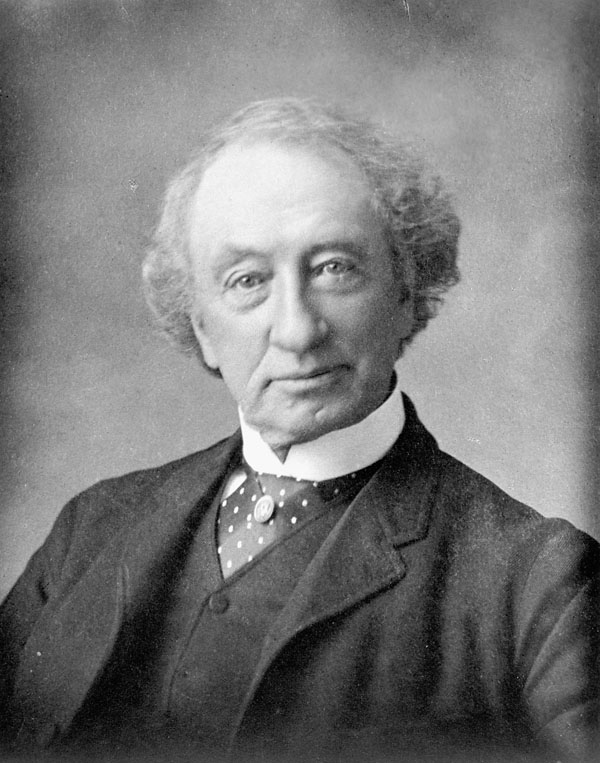
Free trade with the U.S. was the overriding issue in Canada’s 1891 election campaign. Reciprocity was dear to the Reformers (Liberals) of Upper Canada, and Wilfrid Laurier, the national leader, was a proponent as well. It appeared certain that the weary Conservatives and their seventy-six-year-old leader were due for defeat. Sir John A. Macdonald was often ill during the campaign, but he rallied his party around the National Policy, ties to Britain, and the vision of a Canada distinct from the American republic. Macdonald composed an election speech that would become his set piece during the campaign. It is his most memorable address.
The speech
When in 1878 we were called upon to administer the affairs of the Dominion, Canada occupied a position in the eyes of the world very different from that which she enjoys today. At that time, a profound depression hung like a pall over the whole country, from the Atlantic Ocean to the western limits of the province of Ontario, beyond which to the Rocky Mountains stretched a vast and almost unknown wilderness. Trade was depressed, manufactures languished and, exposed to ruinous competition, Canadians were fast sinking into the position of being mere hewers of wood and drawers of water for the great nation dwelling to the south of us.
We determined to change this unhappy state of things. We felt that Canada, with its agricultural resources, rich in its fisheries, timber, and mineral wealth, was worthy of a nobler position than that of being a slaughter market for the United States. We said to the Americans, “We are perfectly willing to trade with you on equal terms. We are desirous of having a fair reciprocity treaty; but we will not consent to open our markets to you while yours remain closed to us.”
The national policy
So we inaugurated the National Policy. You all know what followed. Almost as if by magic the whole face of the country underwent a change. Stagnation and apathy and gloom, aye, and want and misery too, gave place to activity and enterprise and prosperity. The miners of Nova Scotia took courage; the manufacturing industries in our great centres revived and multiplied; the farmer found a market for his produce; the artisan and labourer employment at good wages; and all Canada rejoiced under the quickening impulse of a new-found life. The age of deficits was past, and an overflowing treasury gave to the government the means of carrying forward those great works necessary to the realization of our purpose to make this country a homogeneous whole.
Building the CPR
To that end, we undertook that stupendous work, the Canadian Pacific Railway. Undeterred by the pessimistic views of our opponents, nay, in spite of their strenuous and even malignant opposition, we pushed forward that great enterprise through the wilds north of Lake Superior, across the western prairies, over the Rocky Mountains, to the shore of the Pacific, with such inflexible resolution that in seven years after the assumption of office by the present administration, the dream of our public men was an accomplished fact and I, myself, experienced the proud satisfaction of looking back from the steps of my car upon the Rocky Mountains fringing the eastern sky. The Canadian Pacific Railway now extends from ocean to ocean, opening up and developing the country at a marvellous rate, and forming an imperial highway to the East, over which the trade of the Indies is destined to reach the markets of Europe.
Canals and railways
We have subsidized steamship lines on both sides of the ocean, to Europe, China, Japan, Australia, and the West Indies. We have spent millions on the extension and improvement of our canal system. We have, by liberal grants of subsidies, promoted the building of railways, now become an absolute necessity, until the whole country is covered as with a network, and we have done all this with such prudence and caution that our credit in the money markets of the world is higher today than it has ever been, and the rate of interest on our debt, which is the true measure of the public burdens, is less than it was when we took office in 1878.
Reform-Liberal party gripes
During all this time, what has been the attitude of the Reform Party? Vacillating in their policy and inconstancy itself as regards their leaders, they have at least been consistent in this particular, that they have uniformly opposed every measure which had for its object the development of our common country. The National Policy was a failure before it had been tried. Under it we could not possibly raise a revenue sufficient for the public requirements. Time exposed that fallacy. Then we were to pay more for the home-manufactured article than we used to when we imported everything from abroad. We were to be the prey of rings and of monopolies, and the manufacturers were to extort their own prices.
When these fears had been proved unfounded, we were assured that overcompetition would inevitably prove the ruin of the manufacturing industries and thus bring about a state of affairs worse than that which the National Policy had been designed to meet. It was the same with the Canadian Pacific Railway. The whole project, according to our opponents, was a chimera. The engineering difficulties were insuperable; the road, even if constructed, would never pay. Well, gentlemen, the project was feasible, the engineering difficulties were overcome, and the road does pay. Disappointed by the failure of all their predictions and convinced that nothing is to be gained by further opposition on the old lines, the Reform Party has taken a new departure and has announced its policy to be unrestricted reciprocity . . .
Annexation to the U.S.
It would, in my opinion, inevitably result in the annexation of this Dominion to the United States. The advocates of unrestricted reciprocity on this side of the line deny that it would have such an effect, though its friends in the United States urge as the chief reason for its adoption that unrestricted reciprocity would be the first step in the direction of political union . . .
Flourishing under British Crown
For a century and a half, this country has grown and flourished under the protecting aegis of the British Crown. The gallant race who first bore to our shores the blessings of civilization passed by an easy transition from French to English rule and now form one of the most law-abiding portions of the community. These pioneers were speedily recruited by the advent of a loyal band of British subjects, who gave up everything that men most prize and were content to begin life anew in the wilderness rather than forego allegiance to their sovereign.
To the descendents of these men and to the multitude of Englishmen, Irishmen, and Scotchmen who emigrated to Canada, that they might build up new homes without ceasing to be British subjects; to you, Canadians, I appeal, and I ask you what have you to gain by surrendering that which your fathers held most dear?
Enjoying ample liberty
Under the broad folds of the Union Jack, we enjoy the most ample liberty to govern ourselves as we please and at the same time we participate in the advantages which flow from association with the mightiest empire the world has ever seen. Not only are we free to manage our domestic concerns, but, practically, we possess the privilege of making our own treaties with foreign countries, and in our relations with the outside world, we enjoy the prestige inspired by a consciousness of the fact that behind us towers the majesty of England.
No to American union
The question which you will shortly be called upon to determine resolves itself into this: shall we endanger our possession of the great heritage bequeathed to us by our fathers and submit ourselves to direct taxation for the privilege of having our tariff fixed at Washington, with a prospect of ultimately becoming a portion of the American union?
I commend these issues to your determination and to the judgment of the whole people of Canada with an unclouded confidence that you will proclaim to the world your resolve to show yourselves not unworthy of the proud distinction you enjoy, of being numbered among the most dutiful and loyal subjects of our beloved queen.
A British subject I will die
As for myself, my course is clear. A British subject I was born, a British subject I will die. With my utmost effort, with my latest breath, will I oppose the veiled treason which attempts, by sordid means and mercenary proffers, to lure our people from their allegiance. During my long public service of nearly half a century, I have been true to my country and its best interest, and I appeal with equal confidence to the men who have trusted me in the past and to the young hope of the country, with whom rests its destinies in the future, to give me their united and strenuous aid in this my last effort for the unity of the empire and the preservation of our commercial and political freedom.
Source
Address to the People of Canada by Sir John A. Macdonald, February 1891, Library of Parliament.
Photo
Library and Archives Canada
Discover more from Great Canadian Speeches
Subscribe to get the latest posts sent to your email.

Leave a comment