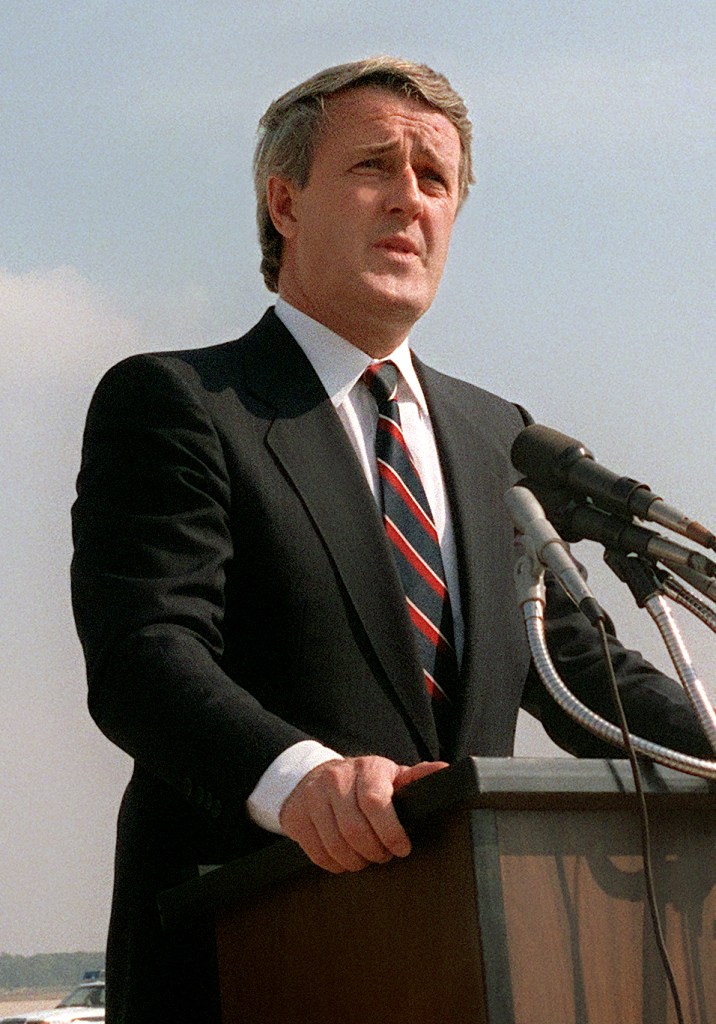
Free trade with the United States has been an enduring issue in Canadian politics. The centerpiece of Sir, John A. Macdonald’s National Policy following Confederation was a tariff to protect Canadian industries. The Liberals were the party of free trade. Sir Wilfrid Laurier fought the 1910 election on reciprocity with the U.S. and he lost. In the 1980s, Liberal Prime Minister Pierre Trudeau appointed a Royal Commission on the economy, and it recommended that Canada take a “leap of faith” on free trade with the U.S. As a candidate for the Progressive Conservative leadership in 1983, Brian Mulroney summoned John A Macdonald and categorically opposed free trade, but after he became prime minister in 1984, he had pivoted dramatically. By the time he gave this speech in Montreal in 1987, negotiations were well underway.
Mulroney’s speech
When we decided to open formal trade negotiations with the United States, we knew the decision would be controversial — one that would arouse old fears and evoke partisan hostility. But we made the decision to move ahead despite these political risks — because it was clearly in Canada’s interest to do so. Why?
Simply put, Canada’s ability to make cultural and social progress depends on continuing economic prosperity. That prosperity depends on our ability to secure and enhance our export markets.
While Canadians export to many countries around the world, our principal export market is, and will continue to be, the United States — our geographic neighbor and the world’s largest and richest market.
We want to build for the future, and these negotiations offer us a unique opportunity to make our economy competitive on a world-class basis.
Two-fold strategy
Our strategy to improve Canada’s trading prospects is two-fold.
We are actively participating in the current round of multilateral negotiations. We want to work within the multilateral framework for lower barriers to trade in all markets, and for clearer rules.
But in promoting these multilateral talks, we also recognize how complex they are and how long it takes to bring them to a successful conclusion. They involve 92 countries – both developing and developed — with differing interests.
Notwithstanding the complexity of these negotiations, they remain important to us, because of the strong interest of Canadian companies in selling goods and services to all countries in the world.
Our decision to negotiate separately with the United States on bilateral issues reflects the urgent need to seek deeper and broader improvements in our most important trading relationship. And to craft an agreement which reflects the unique and compelling interests of our two great countries — a commercial agreement that is deeply rooted in friendship and freedom. That is the essence of our two-track strategy – one that is consistent with our GATT obligations.
Popular support
It is a strategy supported by many of Canada’s leaders and opinion makers in business, in government, in the universities, and in public life.
In its most recent annual review, the Economic Council of Canada states that freer trade with the United States would boost economic growth and employment significantly in Canada . . .
The members of the Macdonald Royal Commission concur, stating that negotiations with the U.S. are “a prudent course which will help to make us richer and, by making us richer, strengthen the fabric of our country and increase our self-confidence. . .”
And our strategy is supported by more than detailed economic studies. We are supported by those organizations on the frontlines — by the Quebec Chamber of Commerce and the Canadian Chamber of Commerce, by the Canadian Federation of Independent Business and the Business Council on National Issues, by the Canadian Exporters Association and the Consumers Association of Canada, and by the Canadian Manufacturers Association.
Canadians will compete
Canadians from all walks of life are ready, willing and able to compete. Because it is in our national interest. And the premiers share these aspirations.
Last night, we held the fourth special meeting of First Ministers to discuss the trade issue. The Premiers fully appreciate that the negotiations are seriously engaged.
And I can report that the provinces and the Government of Canada share the view that an acceptable trade agreement with the United States is in the interest of Canada and all of its provinces and regions.
Critics offer no alternatives
Despite the logic of our approach and its broad support, we recognize and accept that there are some who oppose such a bold initiative.
There are also critics who offer no alternative vision. Let us look at four misconceptions.
Take, for example, our position on the Autopact. We believe the Autopact is working well and to the mutual benefit of both countries. So if it ain’t broke, why fix it?
It appears the Americans agree; their negotiators have not proposed that the Autopact be opened up. That being said, if the U.S. negotiators do have proposals which would be of benefit to Canada, and which would enhance our employment, products and trade, we will obviously listen. It would be foolish to do otherwise . . .
Cultural sovereignty
A second myth is the alleged threat to our cultural sovereignty.
Canadian artists, writers and publishers serve unique Canadian needs, with works which capture and express the Canadian identity. But their domestic audience is relatively small.
For us in Canada, the assistance of the government is needed to overcome the small-scale economies which are a fact of life. That is why we have taken, and will continue to take
steps to strengthen Canadian culture, such as we have done recently for film distribution. In these discussions, Canadian culture is not on the table.
Agriculture
As I have said repeatedly, U.S. and European subsidy programs are unfair and damaging to farmers in Canada and around the world.
Our goal is to help Canadian farmers by increasing the predictability and security of access of exports by the farm sector, by ending the deeply destructive subsidization of exports, while at the same time preserving our farm support policies and the operation of our marketing boards.
Regional development
Some say this government is prepared to sacrifice regional development programs in order to reach an agreement. This, too, is obviously mistaken.
With the Government of Quebec alone we have signed $1.24 billion in new Economic Regional Development agreements (ERDAS).
But we also know that a new agreement with the United States is a critical element for any meaningful regional development strategy.
Because it will undo the damage to the regional economies caused by a century of high tariffs and the constant threat of countervailing duties against regional development assistance.
Any American suggestion that we abandon our commitment to our regional development would be completely unacceptable to this country, given that our regional disparities are so pronounced.
What Canada wants
Now let me discuss what we want from an agreement.
As a matter of the higher priority, we want an agreement that ends the threat to Canadian industry from U.S. protectionists who harass and restrict our exports through the misuse of trade remedy laws.
Let me leave do doubt on three points. First, a new regime on trade remedy laws must be part of the agreement.
Second, the reduction and elimination of tariffs is very important for Canada.
Of course, trade is a two-way street. And our negotiators have been instructed to ensure that the elimination of existing tariffs takes place gradually with adequate transition arrangements that are sensitive to the needs of Canadian industry, and Canadian workers.
Third, it is clear that non-tariff barriers increasingly distort trade. Our negotiators have therefore been instructed to negotiate a broad and comprehensive agreement addressing these issues, including changes to government procurement practices.
These are the principal Canadian objectives. But if the United States wants to increase access to our market; if they truly want Canada to sign precedent-setting agreements which could serve as a model for the world, then our desires must be respected and accommodated. Otherwise, there will be no deal.
We recognize that a good deal must be a fair deal. One that is beneficial to both sides. We are working precisely to that end.
The national interest
We are given a choice. We can look inwards and hope for the best. We can pretend to shelter what we already have while ignoring the realities of the world around us. Or we can look outwards, confidently, and take the future into our own hands.
Source
Address to Chambre de Commerce de la Rive-Sud, Longueuil, Quebec, December 3, 1987, in Canadian Speeches: Volume 01, No. 03, May 1987.
Discover more from Great Canadian Speeches
Subscribe to get the latest posts sent to your email.

Leave a comment