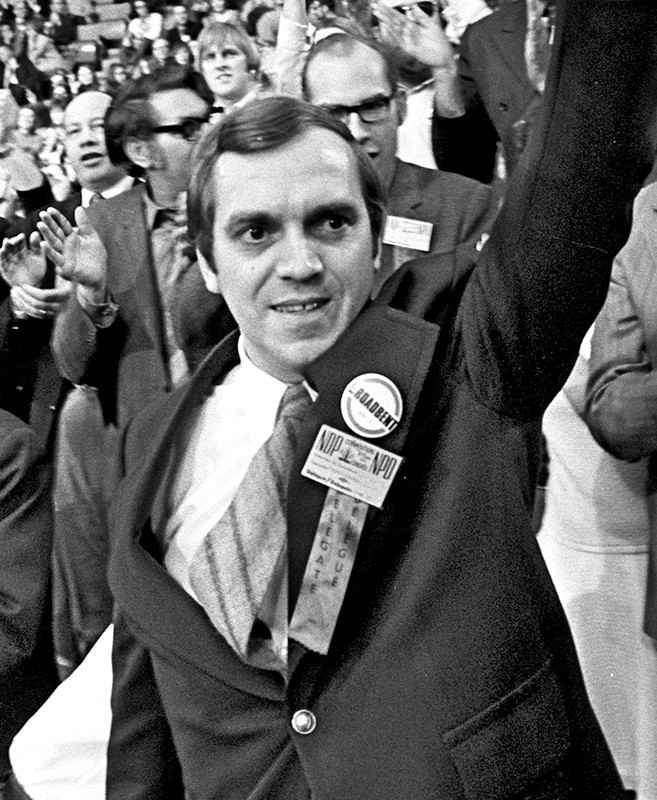
Former leader of the New Democratic Party leader Ed Broadbent would have been 90 years old this year. An academic in Toronto, he returned to his blue-collar hometown of Oshawa, Ontario in a successful bid for a seat in the House of Commons in the 1968. He later led the NDP between 1975 and 1989. After his political career, he was president of the International Centre for Human Rights and Democratic Development, and later still he founded the Broadbent Institute, a progressive think tank. In his first speech in parliament Broadbent said that Canada’s development of the welfare state had stalled, and he argued there was no true democracy without economic equality.
The speech
Mr. Speaker . . . earlier this year the Prime Minister suggested, if I understood him correctly, that in Canada we had gone about as far as we could in our efforts to construct a welfare state. Once we have Medicare established on a national basis, he implied, the structure would be almost complete.
As a member of the opposition, and more particularly perhaps, as a New Democrat, I am in the unfortunate position of having to agree with the Prime Minister on both issues. In short, it seems to me that the debate on the speech from the throne is an occasion when the social philosophical objectives of Canada should be discussed; and, second, it is true that we now have in Canada the basic structural components of a modern welfare state.
A liberal democratic society
I would like to begin my contribution by saying something about the second issue. The 100 years since confederation can be divided roughly into two socioeconomic periods. Up to the 1930’s Canadians were concerned with laying the foundations of a viable capitalist democracy in which our two principal cultural groups could at least co-exist peacefully within the framework of a liberal constitution. The central components of a liberal democratic society were firmly established throughout the land: universal franchise; freedoms of speech, religion, press and assembly; competing political parties, and a national banking system.
Since the 1930s we have experienced important modifications of the classical liberal structure. The more important of these include: the right of trade unions to exist and to strike; the gradual implementation of old age pensions; some form of progressive taxation; comprehensive medical and health programs and an unemployment insurance scheme.
No sensible Canadian would deny that these measures have made a very significant change in the kind of life the majority of our people can now experience. They have provided the quantitative basis for a qualitatively enriched life for millions of adults and children. These five changes have provided the structural core of our modern welfare state . . .
Completing the welfare state
We do have the core of the welfare state. We need only the will to complete it. Houses can be built, taxation can be improved, a guaranteed income can be introduced, and regional disparities can be significantly modified. All this can be done without making any further significant changes in the distribution of power within Canadian society.
It is in this sense that the Prime Minister is almost right when he suggests that in terms of welfare we have gone about as far as we can go. It is also his implied suggestion, that it is as far as we should go, that makes me believe that the Prime Minister is a profoundly conservative man. His vision extends to the welfare state, but not one step beyond. His vision of the just society is what we almost have. To defend what we have and to refuse to go beyond is to cease to lead. And to cease to lead beyond the welfare state is to leave Canadians with a kind of society which is inherently inegalitarian, inherently acquisitive, and inherently unjust . . .
Impoverished democracy
Perhaps the major objection to the welfare state is that for all its advantages it rests on a grossly inadequate understanding of democracy. In Canada today children are taught in schools throughout the land that our country is democratic primarily because there is more than one political party and because citizens have both the right to criticize and the right to change their rulers every few years.
This view of democracy, Mr. Speaker, is a distinctly modern phenomenon and is in marked contrast with the understanding of democracy of both the early Greeks and 19th century Europeans. Prior to our century democracy was seen by its defenders and critics alike as a kind of society in which all adults played an active, participatory role not only in the formal institutions of government but also in all the institutions which crucially affected their daily lives.
Similarly a democratic society had been seen previously as one in which all its members had an equal opportunity to develop their capacities and talents; it was not seen as one in which citizens had an equal opportunity to earn more money or advance up the class ladder. It is this old view of democracy that we must once again take up. We must use its standards and apply them to Canadian society. We must once again talk about equality. We must see justice and equality as going together . . .
Deepening democracy
But what, asks the defender of the status quo, can be done about it? The answer, Mr. Speaker, is a lot. We must begin by insisting that in a democratic society — in, if you would a just society — all adults should have equal rights in all those institutions which directly affect them. Where authority is delegated, then those to whom it is delegated must be responsible to those over whom they exercise their authority . . .
We as the political leaders of the country have a duty to initiate this battle for a truly democratic society. We have a duty, not simply to praise our past and celebrate our present, but also to create the future. We must reject the sterile view of both the government and the official opposition. Both the Liberal and Conservative parties are bound not by bad intentions but by an outmoded and unjust ideology. They have their heads as well as their feet firmly imbedded in the ideas and practices of the past.
The just society
No amount of parliamentary reform, social razmataz, or fiscal responsibility can lead to a just society. At the very most they can remove little pockets of inefficiency. The basic unjust and unequal structure will remain. What Canadians require is a leadership deeply dedicated to the, democratization of the whole of society and thoroughly committed to changing by means of law the existing power relations needed to bring this about. In recent decades we have built a welfare state. It is now time to go beyond it.
Discover more from Great Canadian Speeches
Subscribe to get the latest posts sent to your email.

Thank you for sharing this speech of Ed Broadbent’s. I love how he shows respect for other politicians and the elected leader of Canada. I share in the vision he had. I fear that fewer do with each passing day.
LikeLike
Thank you Lonnie. Always good to hear from you. Yes, Ed Broadbent had a firm set of social democratic beliefs, but he was always careful not to demonize people who, in good faith, had contrasting opinions.
LikeLike