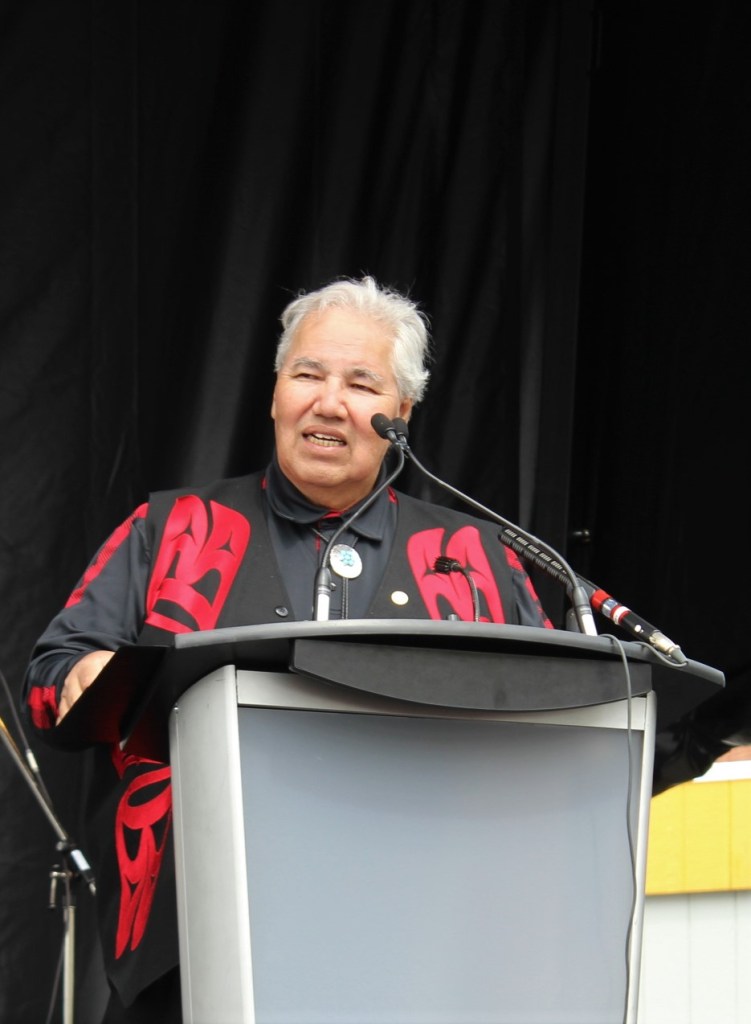
Judge Murray Sinclair led the Truth and Reconciliation Commission which investigated the history of Canada’s residential schools. They were created by the federal government in the 1880s and most often operated by Catholic and Protestant churches. The stated intent was to separate Indigenous children from their families and cultures, forcibly if necessary, and to enroll them in schools which would assimilate them into European culture. More than 150,000 children attended the schools. Many were physically and sexually abused and as many as six thousand died from disease and malnourishment. In 2007, survivors reached a financial settlement with various Christian churches and the federal government. The survivors insisted that a commission be established to investigate the history of the schools. By 2015, more than seven thousand former students had testified before Sinclair and the other two commissioners. Their report issued ninety-four calls to action to the federal government, churches and other institutions in Canada. Sinclair made the following remarks upon the release of his interim report in Ottawa in June 2015.
“Reconciliation involves all of us”
Good morning. Thank you to the traditional keepers of this land, the Kitigaan Zibi Anishnabeg and Pikwàkanagàn First Nations for welcoming us.
On behalf of the Truth and Reconciliation Commission, I welcome you all here today for this very special and very important moment in our history. This has been a difficult, inspiring and painful journey. The residential school experience is one of the darkest, most troubling chapters in our collective history. Despite the many challenges, the Commission and the groups supporting us worked tirelessly, facing the difficult facts about Canada’s residential schools system and the legacy left in its wake . . .
Survivors shared their stories
Ours was a process of research, sharing and above all else, listening. In this way it was a commission like no other. It was set up not by government, but by the parties to the Indian Residential Schools Settlement Agreement seeking to repair the harm caused by residential schools.
In the course of our commission, survivors were not examined as if on trial. Instead, they were invited to share what they had to share – no more, no less – and their stories were recorded into history and acknowledged.
One hundred years of mistreatment
Since 2008, we have collected documents, visited more than three hundred communities from coast to coast to coast and heard testimony from thousands of witnesses. We heard of the effects of over one hundred years of mistreatment of more than one hundred and fifty thousand First Nations, Inuit, and Métis children placed in these schools.
We received statements from individuals who’d been removed from their communities and forced to attend residential schools. We heard from the families and loved ones connected to survivors for whom the effects have been deeply damaging and continue to be felt today. Removed from their families and home communities, seven generations of Aboriginal children were denied their identity.
We heard how, separated from their language, culture, spiritual traditions, and their collective history, how children became unable to answer questions as simple as: Where do I come from? Where am I going? Why am I here? And, who am I?
Their stories, more than six thousand seven hundred and fifty in number, will now become a part of a permanent historical archive, never to be forgotten or ignored.
Administrators haunted by memories
The commission also listened to the stories of some of those who worked at or administered the residential schools . . . individuals haunted by their own memories seeking to come to terms with how destructive the institutions were to Aboriginal people and their culture.
Men and women who understand that the schools were destructive to Aboriginal languages and culture, and who regret being part of these acts. We heard the pain of those charged with the care of those children . . . we heard of the demons they face for not being able to care for them properly or protect them from the abusers. We acknowledge these individuals and thank them for their contributions . . .
Thanking survivors
Mostly, I would like to thank our survivors. The survivors showed great courage, conviction and trust in sharing their stories. These were heartbreaking, tragic and shocking accounts of discrimination, deprivation and all manners of physical, sexual, emotional and mental abuse.
The details of the residential school experience and its impact on the lives of Aboriginal people will be delivered in our commission’s final report, which will be published near the end of this year. The Survivors have entrusted us, and by extension, all the people in Canada, with two priorities.
Understanding leads to action
First, the survivors need to know before they leave this earth that people understand what happened and what the schools did to them. Second, the survivors need to know that having been heard and understood, we will act to ensure the repair of damages done.
And so today we have released these recommendations based on the years of work. The Commission’s recommendations outline specific actions to redress the harmful and disgraceful legacy of the residential school system in Canada.
Cultural genocide
Today, I stand before and acknowledge that what took place in residential schools amounts to nothing short of cultural genocide – a systematic and concerted attempt to extinguish the spirit of Aboriginal peoples . . .
If we are to truly live by our convictions, we must confront and accept that Canada’s history includes a history that’s inconsistent with how we see ourselves. To this end, the Truth and Reconciliation Commission’s recommendations address some of these core challenges . . .
From child welfare to legal and economic concerns . . . from education to language, culture, health, business and commemoration, our ninety-four recommendations endeavour to confront the complexities associated with reconciliation.
United Nations declaration
Central to directing the path to reconciliation will be the Canadian government’s adoption of the United Nation’s Declaration on the Rights of Indigenous Peoples – a declaration that received near unanimity at the UN in 2007. Shamefully, Canada was the only country to raise objections last fall to a UN document reaffirming the declaration.
Many of our Commission’s recommendations are grounded in the principles of the Declaration on the Rights of Indigenous Peoples. This internationally accepted document provides a framework for affirming, respecting and protecting the equality of Aboriginal people and their rights.
The Canadian government’s rejection of the Declaration of the Rights of Indigenous Peoples [in 2007] sends a clear message to Aboriginal people in Canada, all Canadians, and the world. We believe the current government is not willing to make good on its claim that it wishes to join with the Aboriginal people in Canada in “a relationship based on the knowledge of our shared history, a respect for each other and a desire to move forward together” as promised nine years ago.
Words are not enough. Reconciliation requires deliberate, thoughtful and sustained action. Political action will be required to break from past injustices and start the journey toward reconciliation.
The Declaration of the Rights of Indigenous Peoples also recognizes the urgent need to respect and promote the rights of indigenous peoples affirmed in treaties and agreements with other nations.
Royal Proclamation of Reconciliation
To this end, we call upon the Government of Canada, on behalf of all Canadians, to jointly develop with Aboriginal peoples a Royal Proclamation of Reconciliation to be issued by the Crown. The proclamation would build on the Royal Proclamation of 1763, which stated in no uncertain terms that all lands which had not been purchased or ceded to the Crown, were reserved for the Aboriginal inhabitants of the land.
Through the course of time however these agreements were disregarded and ignored by Canada’s governments. As we have learned, governments took further steps to hinder the expression and strength of Aboriginal sovereignty through a variety of means, one of which was the residential school system.
The courts have recognized this history and upheld the nationhood and the rights of Aboriginal people in their legal decisions. Now it is time for Canadian governments and Canadian society to do their part.
This Royal Proclamation of Reconciliation would reaffirm and restore a commitment to the nation-to-nation relationship between Aboriginal peoples and the Crown . . .
Repudiate doctrine of discovery
We call for the proclamation to include a repudiation of the concepts used to justify European sovereignty over Indigenous lands and peoples such as the doctrine of discovery . . . to renew or establish Treaty relationships based on principles of mutual recognition and mutual respect . . . and to reconcile Aboriginal and Crown constitutional and legal orders to ensure that Aboriginal peoples are full partners in Confederation . . .
Reconciliation is not an Aboriginal problem – it involves all of us. The eyes of the world and the gaze of history is upon us. What we do now and in the years ahead matters a great deal. It matters not only for those who are with us today, but also the generations to come and the spirits of those who are not with us here today whose memories we must honour.
Working together
We must work together . . . we must speak the truth. At its heart, reconciliation is about forming respect. The sacred fire lit at sunrise a few days will be extinguished in the coming days. …now we must light this fire within ourselves . . . and let our conviction, courage, commitment and our love keep this fire burning.
More Information
Canadian Encyclopedia on Murray Sinclair
Canadian Encyclopedia on the Truth and Reconciliation Commission
Discover more from Great Canadian Speeches
Subscribe to get the latest posts sent to your email.

Leave a Reply