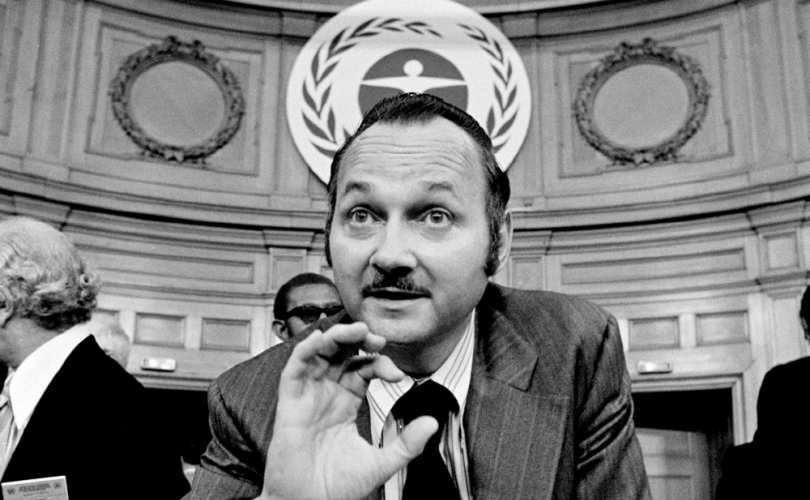
Maurice Strong was a Canadian who played a major role in business and international development. He held senior posts with the United Nations, was the first CEO of Petro-Canada, and served as a chairman of Ontario Hydro. Strong was secretary-general of the 1992 United Nations Conference on Environment and Development, often called the Earth Summit. It brought together leaders from 180 countries in Rio de Janeiro. The summit outlined a comprehensive set of measures to deal with global environmental problems. Strong, in the opening address, insisted that environmental considerations must become central in any consideration of economic policy.
The speech
This is not a single-issue conference. Rather, it deals with the overall cause and effect system through which a broad range of human activities interact to shape our future . . . We have been the most successful species ever; we are now a species out of control. Our very success is leading us to a dangerous future. The concentration of population growth in developing countries and economic growth in the industrialized countries has deepened, creating imbalances which are unsustainable, whether in environmental or economic terms.
Population growth amid inequality
Since 1972, world population has grown by 1.7 billion people, equivalent to almost the entire population at the beginning of this century; 1.5 billion of these live in developing countries which are least able to support them. Each individual person is precious. We must honour, and the earth must support, all its children. But, overall, this growth cannot continue. Population must be stabilized, and rapidly. If we do not do it, nature will, and much more brutally.
During the same twenty-year period, world GDP increased by $20 trillion dollars. Yet only 15 percent of the increase accrued to developing countries. Over 70 percent went to the already rich countries, adding further to their disproportionate pressures on the environment, resources, and life-support systems of our planet. This is the other part of the population problem: the fact that every child born in the developed world consumes twenty to thirty times the resources of the planet than a Third World child.
Imbalance threatens the future
The same processes of economic growth which have produced such unprecedented levels of wealth and power for the rich minority and hopes of a better life for everyone have also given rise to the risks and imbalances that now threaten the future of rich and poor alike. This growth model, and the patterns of production and consumption which have accompanied it, is not sustainable for the rich, nor can it be replicated by the poor. To continue along this pathway could lead to the end of our civilization.
Yet the poor need economic and social development as the only means of relieving the vicious circle of poverty in which they are caught up. Their right to development cannot be denied, nor should it be impeded by conditions unilaterally imposed on the financial flows or trade of developing countries.
Lifestyle of rich unsustainable
The rich must take the lead in bringing their development under control, reducing substantially their impacts on the environment, leaving environmental space for developing countries to grow. The wasteful and destructive lifestyles of the rich cannot be maintained at the cost of the lives and livelihoods of the poor, and of nature.
For the rich, the transition to sustainable development need not require regression to a difficult or primitive life. On the contrary, it can lead to a richer life of expanded opportunities for self-realization and fulfillment, more satisfying and secure because it is sustainable, and more sustainable because its opportunities and benefits are more universally shared.
Sustainable development — development that does not destroy or undermine the ecological, economic, or social basis on which continued development depends — is the only viable pathway to a more secure and hopeful future for rich and poor alike. Fortunately, that pathway is still an option, but that option is closing.
Fundamental changes needed
This conference must establish the foundations for effecting the transition to sustainable development. This can only be done through fundamental changes in our economic life and in international economic relations, particularly as between industrialized and developing countries. Environment must be integrated into every aspect of our economic policy and decision-making as well as the culture and value systems which motivate economic behaviour . . .
First steps in addressing threats
I want to pay tribute to those who have negotiated the Conventions on Climate Change and Biodiversity, which will be opened for your signature here. It has not been an easy process and some have important reservations about both instruments. They represent first steps in the processes of addressing two of the most serious threats to the habitability of our planet. Signing them will not, in itself, be sufficient. Their real importance will depend on the extent to which they give rise to concrete actions and are followed quickly by protocols containing the special measures required to make them fully effective and the finances needed to implement them.
For both these issues deal with the future of life on earth. Over the next twenty years, more than one-quarter of the earth’s remaining species may become extinct. And in the case of global warming, the Intergovernmental Panel on Climate Change has warned that if carbon dioxide emissions are not cut by 60 percent immediately, the changes in the next sixty years may be so rapid that nature will be unable to adapt and man incapable of controlling them . . .
No islands of affluence
Perhaps the most important common ground we must arrive at in Rio is the understanding that we are all in this together. No place on the planet can remain an island of affluence in a sea of misery. We’re either going to save the whole world or no one will be saved. We must from here on in all go down the same path. One country cannot stabilize its climate in isolation. No country can unilaterally preserve its biodiversity. One part of the world cannot live an orgy of unrestrained consumption while the rest destroys its environment just to survive. Neither is immune from the effects of the other.
Exhilarating challenge
Like it or not, from here on in, we’re in this together: rich, poor, north, south, east, and west. It is an exhilarating challenge to erase the barriers that have separated us in the past, to join in global partnership that will enable us to survive in a more secure and hospitable world. This industrialized world cannot escape its primary responsibility to lead the way in establishing this partnership and making it work. Up to now, the damage inflicted on our planet has been done largely inadvertently. We now know what we are doing. We have lost our innocence. It would be more than irresponsible to continue down this path . . .
Unprecedented responsibility
Our essential unity as peoples of the earth must transcend the differences and difficulties which still divide us. You are called upon to rise to your historic responsibility as custodians of the planet in taking the decisions here that will unite rich and poor, north, south, east, and west, in a new global partnership to ensure our common future.
The road beyond Rio will be a long and difficult one; but it will also be a journey of renewed hope, of excitement, challenge, and opportunity, leading as we move into the twenty-first century to the dawning of a new world in which the hopes and aspirations of all the world’s children for a more secure and hospitable future can be fulfilled. This unprecedented responsibility is in your hands.
More information
Maurice Frederick Strong, The Canadian Encyclopedia
Discover more from Great Canadian Speeches
Subscribe to get the latest posts sent to your email.

Thanks Dennis . . . a bit striking to realize that it was almost 35 years ago when Strong set out the case. How far back we have slid in the years of our grandchildrens’ births. At least your efforts have kept a focus on the challenge. Ian
LikeLike
Thanks Ian, for reaching out. It was the Earth Summit in 1982 and a CBC Radio series by David Suzuki a few years later that caught my attention. You are right. Thirty-five years later what science predicted (if we did not act) has come to pass. What do we do now? Something, unless we are absolutely foolish.
LikeLike